

Shita-Tsuki: Kyokushin's Best Punch ("Open the Drawer, Close the Drawer")
Anthony Codispoti ·
5 min read ·
“I think this is the best punch in Kyokushin.” I said it in the middle of a kumite lesson and I’ll stand by it here. Shita-tsuki is the short rising punch to the body, thrown at the close range where most Kyokushin exchanges happen. It is also one of the easiest punches to throw badly, and the mistake is almost always the same one.
What shita-tsuki is
Shita-tsuki is a close-range punch that travels up into the body with the fist turned palm up. In Kyokushin kumite we stand close and trade bare-knuckle shots to the body, and shita-tsuki is built for that distance. It comes in underneath and finds the midsection when the straight punches are getting smothered.
It is not a scooping uppercut. That difference is the whole lesson, and we’ll get to it.
The mistake: leaning and pushing
“When the shita-tsuki happens, people will make the mistake of not bending the knees, and leaning. That’s what happens: a bad punch.”
Leaning does two kinds of damage. First, the punch loses the legs, so all that is left is an arm pushing. Second, your head drifts forward past your front knee, which puts it right in front of whatever the other person is throwing back.
The fix lives in the legs. “If I’m going for the shita-tsuki, my knees bent, and I thrust.” You lower your level by bending the knees, not by folding forward at the waist. Your hips stay underneath you. Then they fire.
Open the drawer, close the drawer
This is the picture I give students. Think of a drawer. It only moves one way: in and out along its track. “The drawer can only go close and open.” You cannot swing a drawer in an arc.
So I drop my level, and the arm works like that drawer. Close the drawer, open the drawer. The upward angle of the punch comes from the knees bending and the hips driving, not from the arm looping up from below. “If you’re throwing an uppercut, there’s an uppercut. You can’t close a drawer that way.”
Get that motion clean and everything else improves. “The better you get at that, the better that shita-tsuki is going to be, and the more power you’re going to throw with it.”
The standard I watch for in class is short: “I just want to know it’s not leaning and pushing. I want to know the hips are going to bend and fire.”
The structure of the fist still matters here. Lead with the two front knuckles and keep the wrist straight, exactly as I teach in how to punch in Kyokushin. A rising punch with a soft wrist is a good way to hurt your hand on an elbow.
Where it fits in a combination
In the full kumite lesson, shita-tsuki comes at the end of a chain that starts with a basic one-two.
One-two.
Step and kick.
Recoil the kick.
Fire the cross-side shita-tsuki with the knees bent.
“Now the athleticism comes in.” When the kick recoils and your foot comes down, your weight is already dropping. Let that drop carry straight into bent knees and the punch. If you stand tall after the kick, you will have to lean to reach the body, and you’re back to the bad punch.
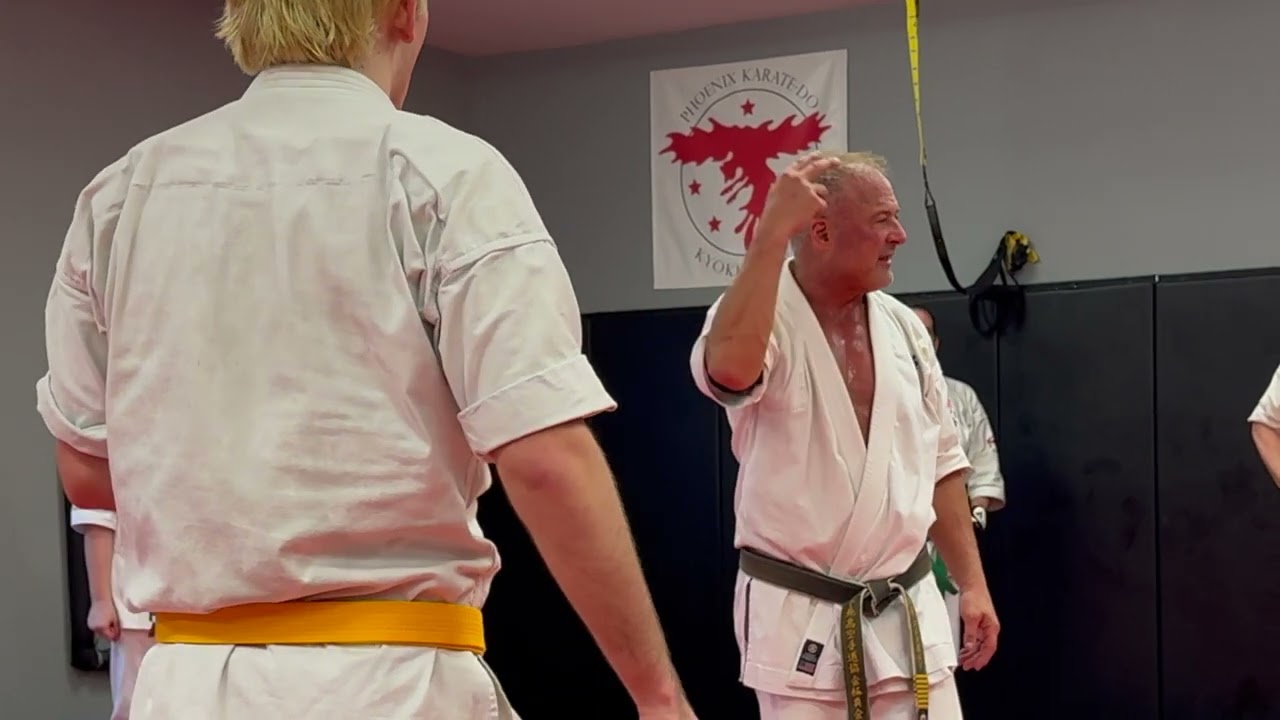
Here is the full lesson. The shita-tsuki section starts near the end, but the whole thing is worth your time.
Watch: Kyokushin Karate Lesson with Shihan – Improving Your Kumite [4K]
I break down the rest of that lesson, including the one-two reset and leg-kick defense, in improve your kumite fundamentals.
How to drill it
Shadow, slow. From your fighting stance, bend the knees and throw the punch at half speed. Watch your head in a mirror. It should drop with your knees, not travel forward past them.
Close-range bag work. Stand close to the heavy bag. Bend, fire, return. Do a set of ten on each side, thinking knees first, fist second.
Add the chain. One-two, step kick, recoil, cross-side shita-tsuki. Keep it slow until the level change happens on its own.
Partner pads. Have a partner hold a pad at body height and call you out every time you lean. In class you’ll hear me say it over and over: “Fire. Don’t lean.”
When it comes out wrong in a drill, keep throwing. I would rather see you firing than stopping to tell me you messed up. That is what I mean when I say you’re in the process.
Common mistakes
Leaning forward at the waist instead of bending the knees.
Scooping the punch up like an uppercut.
Standing tall after a kick, then reaching for the body.
Letting the wrist go soft on impact.
Dropping the other hand away from the face while you punch.
We drill shita-tsuki constantly in our adult class, because almost every close-range exchange gives you a chance to throw it.
Questions
What is shita-tsuki in Kyokushin karate?
Shita-tsuki is a short, rising punch to the body, thrown at close range with the fist turned palm up. Its power comes from bending the knees and firing the hips. I consider it the best punch in Kyokushin.
Is shita-tsuki the same as an uppercut?
No. An uppercut swings up on an arc. Shita-tsuki drives in and out on a straight track, like opening and closing a drawer, and the upward angle comes from dropping your level with your knees.
Why does my shita-tsuki feel weak?
Usually because you are leaning forward and pushing with the arm instead of bending the knees. Drop your level, keep your hips underneath you, and let them fire as the punch lands.

Anthony Codispoti
Shuseki Shihan, Founder & Headmaster
Founder and headmaster of The Phoenix Way in Shrewsbury, NJ.
More from Kyokushin Technique


30 days free
We are the only facility in the area confident enough to offer you 30 Days Free. What do you have to lose?
170 Patterson Ave, Shrewsbury, NJ 07702
Claim your free month
Your name and email address will not be sold, shared, or disclosed to anyone. We promise to respect your privacy.

© 2026 The Phoenix Way